
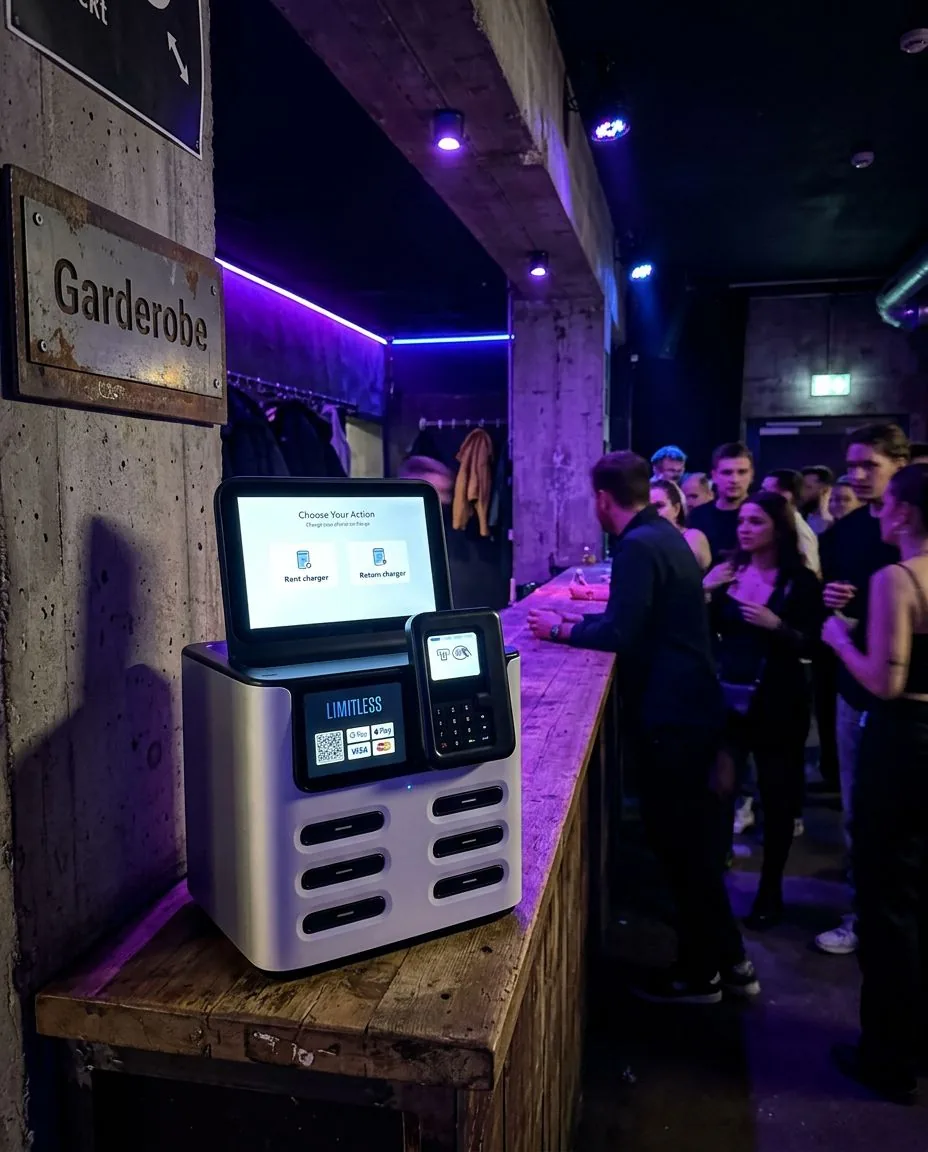
There is no honest single number to answer "How much can you earn with powerbank sharing?". Instead, there is a counter-question: where will the station be? Revenue is not made by the hardware, nor by the price you set. Revenue is made by the venue. The same station brings in around €50 a month in a bakery and ten times that in a busy club, with identical technology and an identical rental price.
In brief
How much you earn with powerbank sharing depends mainly on the location. Based on figures from our network, a station brings in about €320 to €590 net per month in a club, about €220 to €435 in a cocktail bar and often less than €100 in a café. There is no guarantee.
Contents
That is why we are not giving you one number here, but three things: what is realistic at each type of venue, how to recognise a good venue, and how the calculation from gross to net actually works.
The short answer
A solid location, let's say a restaurant with evening trade, gets just under 3 rentals a day on a conservative estimate, so around 85 a month. At €4 gross per rental, that is around €340 gross revenue per month per station. After VAT, payment fees, the Limitless share and, if the station is in someone else's venue, the location partner's share, you are left with about €150 to €220 net per month. A Solo package pays for itself after around seven months.
The €4 per rental comes from our recommended price of €2 per started half hour and an average rental time of around 48 minutes. That is the middle. At the bottom end it goes below €100, at the top end it can be several times that. Which case you will be is decided almost entirely by the address.
Why revenue depends on the venue, not on you
A powerbank is not rented because it is there. It is rented because someone has a problem at exactly that moment: 14% battery, the evening is just getting started and it is a long way home. This problem does not occur equally often everywhere, and above all not equally often at every time of day.
The later it gets, the emptier the batteries. A phone that starts at 100% in the morning is down to 15% by 11 pm, after a day of work, messages, navigation and a few hours of music and photos. That is exactly when the guest has to choose: call it a night or rent a powerbank. That is why the same station earns many times more at midnight than in the afternoon, and why clubs, late-night bars and shisha bars are at the top of the table below.
For the problem to arise at all, three things have to come together. The guest has to stay long enough. They have to use their phone: taking photos, streaming music, paying, planning the way home. And they must have no free alternative, so no charging cable behind the bar.
Everything you can control yourself (price, package size, how the station is angled) moves revenue by maybe 10 to 20%. The choice of venue moves it by a factor of 10. That is why this article talks more about venues than about calculations.
What each type of venue can bring in
The following figures are benchmarks based on experience from day-to-day operations, calculated at €4 gross per rental. The net column applies if the station is in your own venue, i.e. after 19% VAT, around 4% payment fees and the 20% Limitless share, with no location partner share.
| Venue | Rentals / month | Gross / month | Net / month |
|---|---|---|---|
| Club, nightclubonly 2–3 nights a week, but very busy and late | 125–230 | €500–920 | €320–590 |
| Shisha bar, late-night barvery long stays, young crowd | 105–210 | €420–840 | €270–540 |
| Cocktail bar, trendy bar | 85–170 | €340–680 | €220–435 |
| Bowling, billiards, leisure centre | 85–170 | €340–680 | €220–435 |
| Restaurant with evening trade | 70–140 | €280–560 | €180–360 |
| Hotel or hostel lobby | 40–105 | €160–420 | €100–270 |
| Gym | 30–85 | €120–340 | €75–220 |
| Hairdresser, beauty, nail salon | 20–55 | €80–220 | €50–140 |
| Café, bakery, snack barshort stays, usually does not pay off | 15–40 | €60–160 | €40–100 |
Benchmarks, not a promise. Actual earnings depend on location, footfall, crowd, time of year and your rental price.
The jump from the bottom to the top of this table is roughly a factor of 8. And it does not cost you a cent more, because the station is the same. It just costs you a few more weeks of care when choosing.
Two things stand out. First, a club is at the very top even though it only opens two or three evenings a week, because on those evenings almost every guest stays five hours, has their phone in their hand the whole time, and the night is longest exactly when batteries are emptiest. Second, cafés and bakeries are at the bottom even though a lot of people pass through every day. Footfall alone is not enough. What counts is how long someone stays, and what time they are there.
What makes a good venue
If you have a specific venue in mind, go through these seven points. The more of them apply, the higher up the table you will land.
- Stays of more than two hours. By far the most important point. Someone grabbing a takeaway coffee will not rent a powerbank. Someone staying for the evening will.
- Late opening hours. Batteries are empty at 11 pm, not at 9 am. Every extra hour a venue stays open is disproportionately valuable: the last two hours before closing often bring more rentals than the whole afternoon. Venues with night-time trade clearly beat venues with steady daytime trade, even with the same number of guests.
- A crowd with phones in their hands. Photos, stories, music, booking a taxi, paying by phone. Where people film a lot, they rent a lot.
- No substitute on site. If there is a charging cable for guests behind the bar or free sockets everywhere, the station loses its purpose.
- A visible spot. Counter, cloakroom, entrance, till: where everyone passes and waits anyway. Not in the corner next to the toilets. In the photo above, the station is in exactly the right place: right on the counter, under the cloakroom sign.
- Staff who get on board. One sentence from the bartender ("by the way, we have powerbanks") makes a huge difference in the first few weeks. Where the team ignores the station, it takes much longer to get going.
- Returning guests. Anyone who has used the station once will use it again. Regulars are worth more than passing trade.
The rule of thumb behind it: invest your time in choosing the location, not in pricing. A good location forgives a mediocre price. No price can save a bad location.
From gross to net: the calculation
Up to four items are deducted from gross revenue:
- VAT: 19%, included in the rental price. Limitless pays it as the contracting party of the guests.
- Limitless share: 20% of net income, i.e. after VAT and payment fees. 80% goes to you. This covers the app, backend, payment processing, monitoring and support. There is no licence fee.
- Location partner's share: only relevant if the station is in someone else's venue. Negotiable, but negotiate the right way round: offer it free first, and if you have to, give away 20% at most. More on that below.
- Payment fees: the usual fees for card processing, which we put at around 4% in our calculation.
What is left is your net income. The amounts exclude VAT: unless you are a small business exempt from VAT, VAT is added to your payout and you pay it to the tax office. Here are two worked examples:
Case 1: your own venue
You run a bar or restaurant yourself and put the station on your own counter. There is no location partner.
- just under 3 rentals a day, so around 85 a month
- 85 × €4 = €340 gross per month
- minus 19% VAT (≈ €54) and around 4% payment fees (≈ €14) = ≈ €272 net income
- 80% of that for you: ≈ €220 net per month
A Solo package therefore pays for itself after around seven months. From then on, it is ongoing cash flow. And that is the conservative version: at the locations in the top rows of the table, double or triple is realistic.
Case 2: someone else's venue, as a licensing partner
You do not have your own venue but place stations with partners. Calculated with a 20% location partner share:
- €340 gross per month, of which ≈ €220 net for you (as in case 1)
- minus a 20% location partner share of gross revenue (€68)
- ≈ €150 net per month per station
Pitch it free first, talk percentages later
The most common beginner's mistake is to open the first conversation with a revenue share. There is no need. For most venue owners, the station is already a win without any share: it costs them nothing, they do not have to do anything, and it solves three problems they have anyway:
- Less liability risk. Anyone who lends guests a charging cable behind the bar today may be liable for the device if something goes wrong: a damaged phone, a missing cable, an overloaded socket. With the station, this runs through a clear contract between the guest and the station operator, not through the venue.
- Fewer tangled cables and less work for staff. No hunting for the charging cable, no phone behind the bar that someone has to keep an eye on, no discussion about who gets the socket next. The issue is simply off the table.
- Higher spending. The most important point for the conversation: a guest with a flat battery leaves. A guest with a charged phone stays, and orders another round. A single extra order per evening is worth more to most venues than any revenue share you could negotiate.
So run the conversation in this order: first the benefit for the venue, then the free spot for the station. A lot of owners say yes at this point. Only if someone explicitly wants a share do you talk percentages, and then in practice the rule is: 20% at most. Above that, the numbers stop working. At 30% or more, you are essentially working for the venue, and the payback period stretches to more than a year.
When does the station pay for itself?
As a guide, in the conservative calculation (≈ €220 net per month at your own venue):
- Solo (1 station): around 7 months
- Squad (5 stations): similar per station, slightly faster overall thanks to the lower unit price
- Network (10 stations): lowest unit price per station, pays for itself fastest
At a venue from the top rows of the table, this time halves or better. At one from the bottom rows, it doubles or triples, which is why this whole article is about venues. The best way to work out the figure for your specific case is to do it yourself: in the profit calculator → you can set footfall, price and package as you like.
We find the venue together
You do not have to make this assessment on your own, and you shouldn't. We see the figures from all running stations, so we know pretty precisely what a certain type of venue brings in at a certain location.
In practice, that means:
- Already have a venue in mind? Send it to us. We will tell you honestly which row of the table it falls into, even if the answer is "we would advise against it". A poorly chosen first location is the most common reason for disappointed newcomers, and that is in nobody's interest, least of all ours.
- Not sure where yet? Then we go through together which type of venue you can realistically win in your city and how to approach the owner. We give you the arguments from above (liability, tangled cables, spending) to take with you.
- Where in the room? We discuss that too. Whether the station is on the counter, at the cloakroom or at the entrance makes a double-digit percentage difference in practice.
What you should not expect
Powerbank sharing is a solid additional business, not a get-rich-quick promise. Three honest points:
- There is no revenue guarantee. We give you figures based on experience and an honest location assessment, but no promise of specific revenue.
- The first few weeks are a learning phase. Plan time to test the price and get the staff used to the concept.
- A single station is a start, not a full-time income. The real leverage comes from several stations, ideally as a cluster in one city, so guests can return the powerbank at any of your stations.
Frequently asked questions
How much do you earn with one powerbank station?
That depends on the location. Figures from our network range from under €100 net per month in a café to around €320 to €590 in a busy club.
Which type of venue brings in the most revenue?
Clubs, late-night and shisha bars, and cocktail bars, because guests stay a long time and use their phones a lot. Cafés and snack bars with short stays usually do not pay off.
What is deducted from revenue?
VAT included in the price and payment fees are deducted from gross rental revenue. You receive 80% of the remaining net income and Limitless keeps 20%. If the station is in someone else's venue, an agreed share for the location may be added.
Is there a revenue guarantee?
No. The figures given are based on experience, not a promise. How much a station brings in depends on the venue, footfall and placement.